The comparison methods desk
Tirzepatide versus placebo: what a symptom comparison can establish
A useful medication comparison identifies the alternative, the measured experience and the people represented. This analysis examines the design choices needed to interpret a symptom contrast and to ask a different comparative question.
Published · 12 minute read
A research figure can make a medication comparison appear immediate: identify the shorter bar and choose an interpretation. The harder work happens before that visual judgment. The alternatives, outcome definition and observation rules determine which question the figure can address. A clear account of those choices is essential when the question changes from an active medicine against a control to a choice between active medicines.
This article develops the methodological questions behind that distinction. The accompanying figure preserves the selected source measurements; the discussion examines how assignment, reporting, denominators and treatment changes shape their interpretation. The purpose is to make the comparison more precise, including the information another design would need, rather than turn a symptom summary into a general medication ranking.
Wide tables can scroll horizontally. Keyboard users can focus a table region and use the arrow keys to move across it.
Reading the evidence
- Name both alternatives
- A comparative claim changes when its comparator changes.
Sources: [2]
- Keep the unit visible
- Group membership, symptom records and observation time describe different quantities.
- Define the outcome
- Occurrence, duration, severity and recurrence require distinct measurement rules.
Sources: [2]
- Specify later changes
- The target question determines how treatment changes should enter an analysis.
Sources: [2]
- Connect indirect evidence
- A shared comparator name needs a supporting argument about study compatibility.
Sources: [2]
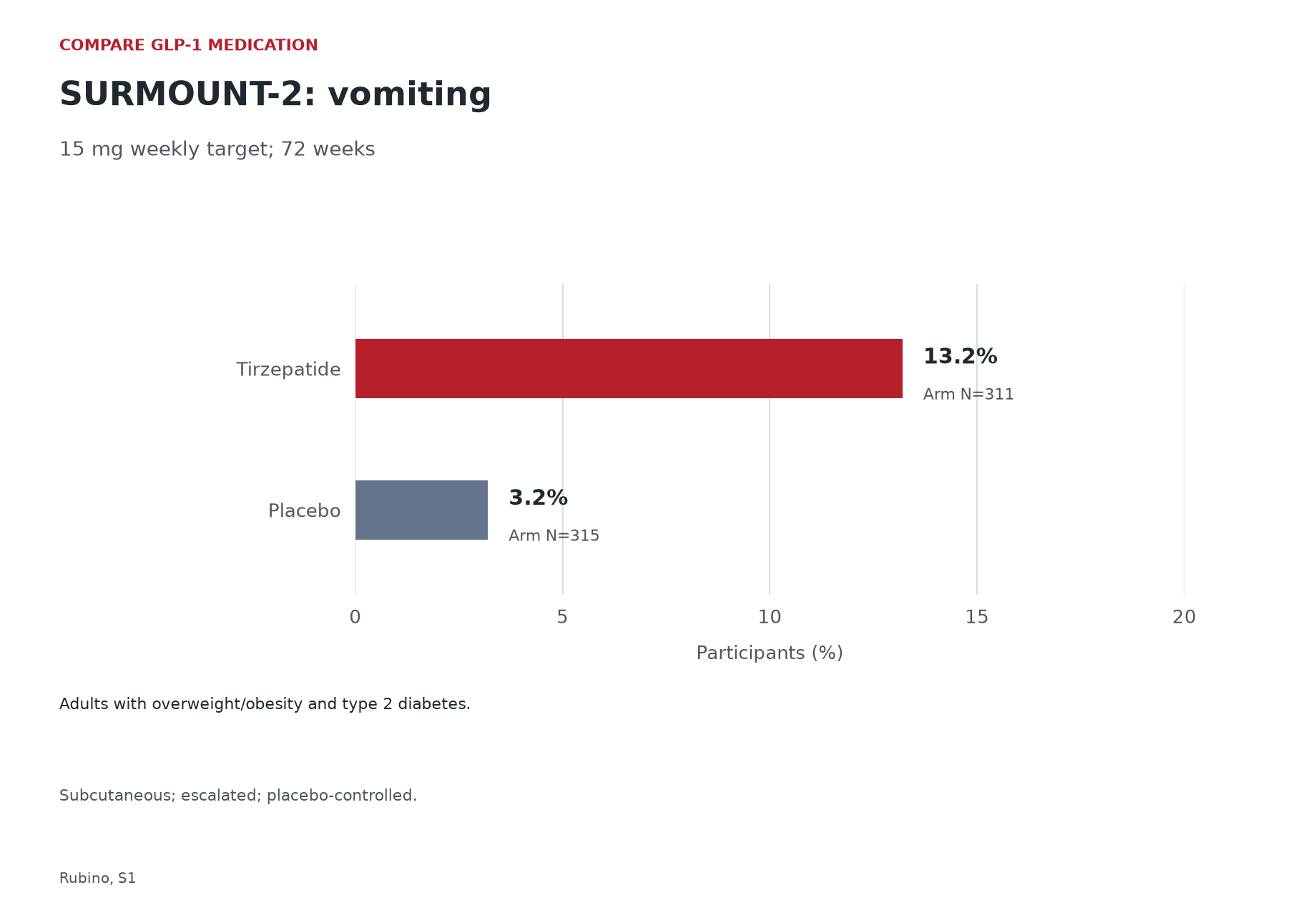
SURMOUNT-2: vomiting
15 mg weekly target; 72 weeks
Adults with overweight/obesity and type 2 diabetes.
Subcutaneous; escalated; placebo-controlled.
Sources: [2]
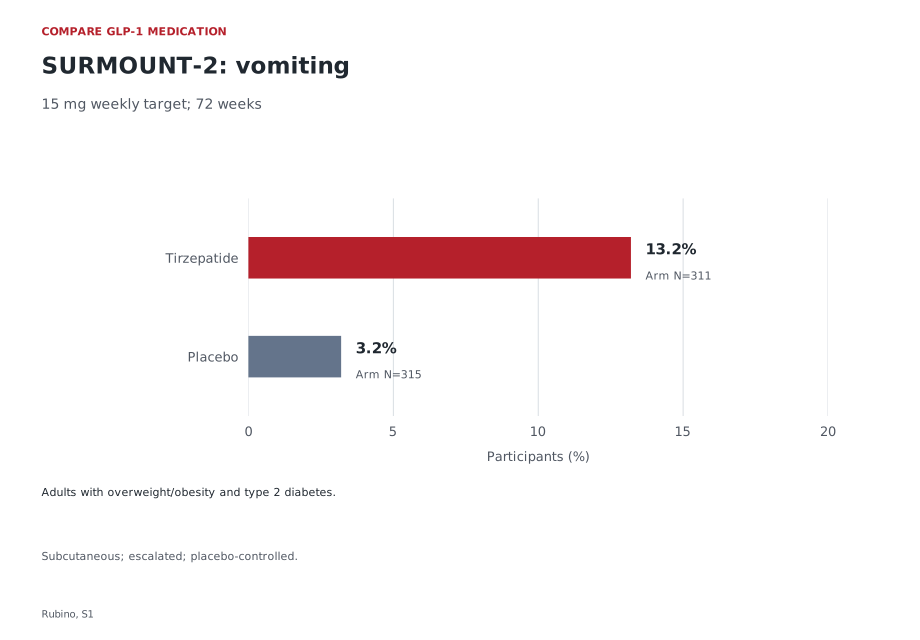
| Arm | Arm N | Participants (%) |
|---|---|---|
| Tirzepatide | 311 | 13.2 |
| Placebo | 315 | 3.2 |
The comparator defines the claim
Lilly funded this post hoc analysis; several authors were employees. Events were self-reported. Analyses excluded data after treatment discontinuation or antihyperglycemic rescue. The symptom table labels its leading counts ambiguously; only percentages and total arm sizes are reproduced.
A medication comparison begins with a contrast: which alternative is being considered against which other alternative? The outcome, population and observation period belong in that question too. Changing the comparator changes the question, even if the medicine named first stays the same. This is why a discussion of semaglutide and tirzepatide needs evidence connecting those alternatives, rather than separate descriptions of each one.
The distinction matters because an observed outcome has meaning within a specified study setting. A percentage describes a defined group under a particular measurement rule. A comparison asks how that outcome differs between alternatives. A causal interpretation goes further, asking what would happen under different assignments for an otherwise comparable population. Those steps require additional reasoning; the visual separation between bars cannot supply the missing design information.
A useful first step is to write the research question as a complete sentence before interpreting its answer. Specify who is represented, what is assigned and which experience counts toward the outcome. Then ask whether the available observations and analysis actually address that sentence. This keeps a narrowly defined symptom comparison useful without stretching it into a judgment about every possible treatment goal.
Sources: [2]
Randomization belongs to the assigned alternatives
Random assignment creates a comparison through the way alternatives are allocated. Its value is tied to that allocation process: it provides a basis for comparing groups without deliberately assigning one option according to a participant's expected outcome. It does not make every characteristic identical in the particular sample that happens to result. Chance differences remain possible, and uncertainty must accompany the estimate produced from that sample.
That design protection does not travel automatically with a drug name. Placing an estimate from one randomized study beside an estimate from another does not reproduce the assignment that would have occurred if those medicines had been offered as alternatives in a common study. Differences between study populations and procedures enter the comparison. The word randomized describes an actual design feature, not a general certificate attached to every later use of its results.
Assignment also needs to be distinguished from what happens afterward. Participants may contribute different amounts of information or follow different treatment paths. The analysis must explain how those paths relate to its intended question. Separately, eligibility defines who could enter the research population; it does not resolve how a result should be transported to people outside it. Internal comparison and wider applicability require related but distinct arguments.
Sources: [2]
An event in the control arm still needs interpretation
A control condition still has an outcome distribution. Recording a symptom in that condition establishes an observation under its measurement rules. It does not identify the cause of that particular experience. Many explanations could be considered in a broader investigation, but naming a plausible explanation is not evidence that it accounts for an observed event. A causal claim requires information capable of distinguishing between the competing explanations.
This becomes especially important when reasoning about individuals. An observed person follows one course through a study, while the counterfactual question concerns what would have happened to that same person under another course. The other course is not directly observed alongside the first. A group comparison can inform a population question without identifying which particular person's experience would have been different under the alternative assignment.
The control condition must therefore be described as carefully as the active condition. A proposed study should specify the surrounding care, contact opportunities and outcome collection that accompany each assignment. Those details help define what is being compared. If a comparison includes several differences in care at once, its interpretation concerns that combined contrast unless the design can separate the components. This is a design question, not a reason to attribute symptoms to expectations or another unmeasured mechanism.
Sources: [2]
Symptoms become data through reporting rules
A symptom name is the beginning of a measurement definition. Researchers still need a rule for deciding when a report qualifies, how separate reports are distinguished and which observation window is relevant. A broad category and a narrowly defined episode can organize experience differently. Before combining records, the analyst should be able to describe the common variable that each record is intended to represent.
Severity, duration and recurrence are additional dimensions. A variable indicating whether a symptom occurred does not automatically contain how intense it was, how long it lasted or how often it returned. A future analysis could examine those dimensions separately, but it would require measurements designed to retain them. Our side-effects guide provides a related reading route; the methodological issue here is the definition of the measured outcome, rather than personal symptom management.
Collection timing also deserves an explicit plan. A question asked at intervals and a record entered whenever an experience occurs organize reporting differently. Researchers would need to document the method, examine missing entries and consider whether measurement operates comparably across assignments. These are requirements for interpreting a proposed comparison. They do not establish that any particular reporting problem occurred, or that a different collection method would necessarily move the result in a predictable direction.
Sources: [2]
An arm size is not a symptom count
The size of a treatment arm identifies membership in a group. It does not, by itself, identify the number of usable observations for every outcome. Some questions concern people who satisfy an outcome definition; others concern separate occurrences or time under observation. These quantities may be related, but each needs its own label. Treating them as interchangeable can change the meaning of an otherwise correctly transcribed number.
Arithmetic consistency cannot resolve a definition that remains unclear. A calculation may resemble a displayed percentage while leaving unanswered what the numerator represents, how the denominator was selected or which records were eligible. Rounding adds another reason to avoid treating a reverse calculation as recovery of an original dataset. The defensible starting point is the documented unit of observation, followed by the documented relationship between the fields.
A data dictionary would make those relationships explicit: the entity counted, the condition it must meet, the observation window and the rule for repeated records. It would also distinguish membership from availability at a later assessment. The companion analysis of event rates and patient risk develops why changing the denominator changes the question. A larger collection of numbers is not necessarily more informative when the identities of those numbers remain uncertain.
Treatment changes can change the question being estimated
Treatment changes create a choice about the question an analysis is meant to answer. One possible question follows people according to their original assignment, including what happens after later changes. Another asks about experiences during a defined period of continued exposure. These questions can both be meaningful, but they describe different conditions. The choice should be stated before interpreting a result as though it applied equally to both.
The information needed also differs. Following an assigned strategy through later changes requires continued outcome collection and a clear account of those changes. Restricting observation to a particular exposure condition requires a rule for when that condition starts and ends. If observation depends on events that also relate to the outcome, additional assumptions may be necessary. The existence of such a possibility does not establish its direction or size in a particular study.
An analysis plan should connect the target question, available observations and proposed sensitivity checks. A sensitivity analysis asks how conclusions would change under specified alternative assumptions; it cannot replace missing information without assumptions of its own. Different treatment goals may call for different outcomes and observation strategies. Specifying that connection is more informative than assigning a broad methodological label to a table whose complete analytic question has not been established.
The unit of exclusion matters as well. Removing observations after a specified change is different from removing every observation contributed by anyone who experiences that change. Those choices retain different histories and can represent different questions. An adequate analysis description should distinguish the person, the record and the eligible observation period, so a reader can understand what information remains without reconstructing an undocumented dataset.
Sources: [2]
A shared placebo label is not enough for an indirect comparison
An indirect comparison needs a connection between the alternatives. Sharing a comparator name can provide a proposed structure for that connection, but the name alone does not show that the studies estimate compatible quantities. The comparison must account for what each condition involves, who contributes information, how the outcome is defined and when it is measured. These are parts of the scientific question rather than optional descriptive details.
A further concern is whether the treatment contrast could vary with characteristics distributed differently across studies. Such a characteristic is relevant because it may modify the comparison, not merely because its average differs. Deciding which characteristics matter requires a scientific argument and adequate data. Adjusting for a convenient list of recorded variables does not, by itself, establish that every relevant difference has been addressed or that remaining uncertainty is negligible.
The methods table separates possible comparison structures from the assumptions they would require. It does not perform an indirect calculation. A defensible analysis would define a common target population and outcome, examine whether the studies can inform that target and carry the uncertainty through each step. If a necessary connection is unsupported, that is a specific limitation of the proposed inference; it is not evidence that the medicines are equivalent or that one is superior.
| Proposed contrast | Required connection | Unresolved assumption |
|---|---|---|
| Within-trial active versus control | Assignment and outcome collection within a common design | The analysis addresses the stated question despite changes or missing observations |
| Anchored indirect comparison | Compatible comparisons connected through a common alternative | Relevant differences across studies are adequately accounted for |
| Direct active versus active assignment | Competing strategies assigned within the same study | Observation and analysis preserve the intended contrast |
Sources: [2]
Designing a comparison between active medicines
A comparison between active medicines begins by defining the treatment strategies, not just naming ingredients. A strategy includes how treatment is initiated, how subsequent changes are handled and what accompanying care belongs to the assigned alternative. Questions about oral formulations illustrate why route belongs in that specification. An intervention cannot be assumed equivalent to another solely because a familiar name appears in both descriptions.
The outcome plan should then state which experiences are primary, how they will be collected and what constitutes a meaningful interpretation. A symptom occurrence measure, a duration measure and a severity measure would require different information. Examining several outcomes can be valuable, but selecting a favorable result afterward creates a different evidentiary situation from following a prespecified analysis. A clear plan should address uncertainty and multiple comparisons without implying that any particular adjustment has already been performed.
Even a direct randomized comparison would remain specific to its defined outcomes and population. A result concerning one experience would not settle every other benefit, harm or practical consideration. The goal is therefore an interpretable comparison with a transparent scope, rather than a universal winner. The proposed alignment table identifies the documentation needed to connect an outcome estimate to that scope and to recognize when a later claim asks a broader question.
| Feature to align | Measurement needed | Interpretation protected |
|---|---|---|
| Active regimen | Assigned strategy and subsequent treatment paths | Which alternatives the result concerns |
| Symptom definition | Qualifying experience, collection process and observation window | What the outcome actually measures |
| Treatment changes | Timing, reasons and continuing outcome information | How later changes enter the target question |
| Uncertainty across prespecified outcomes | Estimation plan and approach to multiple comparisons | How much confidence each stated comparison supports |
Sources: [2]
Keep population evidence separate from individual care
Zepbound’s current label describes severe gastrointestinal reactions and dehydration-related kidney injury. It is not recommended with severe gastroparesis. Patients are told to contact a clinician about severe or persistent digestive symptoms. This is a limited safety summary, not the full prescribing information or a personal treatment recommendation.
A population estimate can inform a discussion without determining an individual's clinical assessment. The scientific comparison and the person's care decision have different information requirements.
Sources: [4]
What would make the comparison more informative
The next useful research step is to specify the comparison that remains unresolved. Name the target population, competing strategies, outcome definition and observation period. Decide how treatment changes enter the question and which missing observations would prevent an answer. This specification turns a broad request for more evidence into a set of concrete requirements that another study or an additional analysis could be designed to address.
Separate the unit of a clinical comparison from the unit of a service comparison. Our guide to clinician and pharmacy roles concerns who performs different parts of care. A provider comparison scorecard organizes a different set of attributes. Neither kind of organizational description supplies a randomized medication contrast. Keeping those units distinct prevents a result about a treatment strategy from being repurposed as evidence about an institution's performance.
For a scientific extension, the most valuable additions would clarify information that changes the inference: compatible outcome definitions, reasons for unavailable observations, the treatment paths represented and uncertainty around the specified contrast. Extra decimal places or a more elaborate graphic cannot substitute for those definitions. The quality of the comparison depends on how well its design and records answer the chosen question, including the parts that remain unresolved after the estimate is displayed.
Sources: [2]
Questions about the evidence
Why does the identity of the comparator matter?
A contrast concerns what happens under one alternative relative to another. Substituting a different comparator changes that contrast, even when the first medicine is unchanged. The evidence must connect the actual alternatives of interest under a compatible outcome definition and observation plan; the name of a medicine cannot carry the missing comparison by itself.
Sources: [2]
Does an event in a control group explain why it happened?
The record establishes an observation under the study rules. It does not identify the cause of that individual experience. Distinguishing possible causes requires additional information or design features. A population comparison and an explanation of one person’s experience are different inferential tasks, so the same observation need not answer both.
Sources: [2]
Why is the symptom name insufficient as a measurement definition?
A useful definition also establishes which reports qualify, how separate occurrences are distinguished and which period is observed. It should state whether duration, severity or recurrence is retained. Without those details, matching words in different reports can conceal different variables, and combining them may answer a question that neither study originally specified.
Sources: [2]
What does Arm N tell a reader?
It identifies the size of the designated treatment group. A particular analysis may require additional definitions for the observations available, the outcome condition and repeated records. The group size alone does not identify all those quantities. Their relationship should come from documented field definitions, rather than a calculation that merely appears to reproduce a displayed value.
Sources: [2]
When could an indirect comparison be informative?
It could be informative when a justified connection links compatible study contrasts to a common target question. That requires examining outcome definitions, treatment strategies, observation periods and characteristics that may modify the comparison. The assumptions and uncertainty need to remain visible. A shared control label is a starting structure for that work, rather than its completion.
Sources: [2]
Editorial assessment
The most useful reading of a symptom comparison preserves the question that generated it. Identify the alternatives, define the measured experience, distinguish group membership from usable outcome information and explain how subsequent treatment paths affect the analysis. A different comparative question may need a different design or a justified connection between studies. That requirement gives future research a concrete direction: improve the match between the intended contrast and the information capable of supporting it.
Sources and access
- Wharton: semaglutide tolerability
Article and supplement checked.
Checked: .
- Rubino: tirzepatide tolerability
Article and supplement checked.
Checked: .
- DailyMed: Wegovy
Current label checked.
Checked: .
- DailyMed: Zepbound
Current label checked.
Checked: .